Content over impact
The portfolio led with polished visuals and project quantity, but gave hiring decision makers little evidence of business thinking or measurable outcomes.
My previous portfolio was getting traffic but visitors were leaving without reaching out. That told me the work wasn't doing its job. I redesigned it with one clear goal: turn visitors into conversations.
Role: UX/UI Designer and Owner
Duration: 3 months
Status: Live
Results: In progress - (tracked via Google Analytics, with success measured by interview conversions and inquiries post-launch)
Between January and February 2026, the portfolio recorded 102 active users, 169 page views, and 423 events — but an average engagement time of 0s and a 55.6% bounce rate. Traffic existed but engagement and action didn't.
The portfolio wasn't communicating what hiring decision makers needed to make a confident hiring decision.
I reviewed qualitative data from Reddit, X, and LinkedIn alongside industry articles and multimedia content.
By synthesizing candid feedback from senior practitioners and hiring managers, I mapped the most common portfolio pain points shown below. (weighted by frequency across the sources - x% of insights)
Limited demonstration of business acumen (35%)
Insufficient evidence of real working behavior (29%)
Quality over quantity emphasis (18%)
Unclear individual contribution (18%)
Applying these insights to my previous portfolio revealed similar friction points.
The portfolio led with polished visuals and project quantity, but gave hiring decision makers little evidence of business thinking or measurable outcomes.
How Cathy worked, thought, and contributed was hidden behind expandable sections and thin project descriptions making it hard to assess fit quickly.
Press play to view the previous design↓
By making business acumen, individual impact, and real-world performance immediately visible, the goal was to give hiring decision-makers what they need to evaluate professional credibility fast.
The new portfolio design is grounded on these 3 principles;
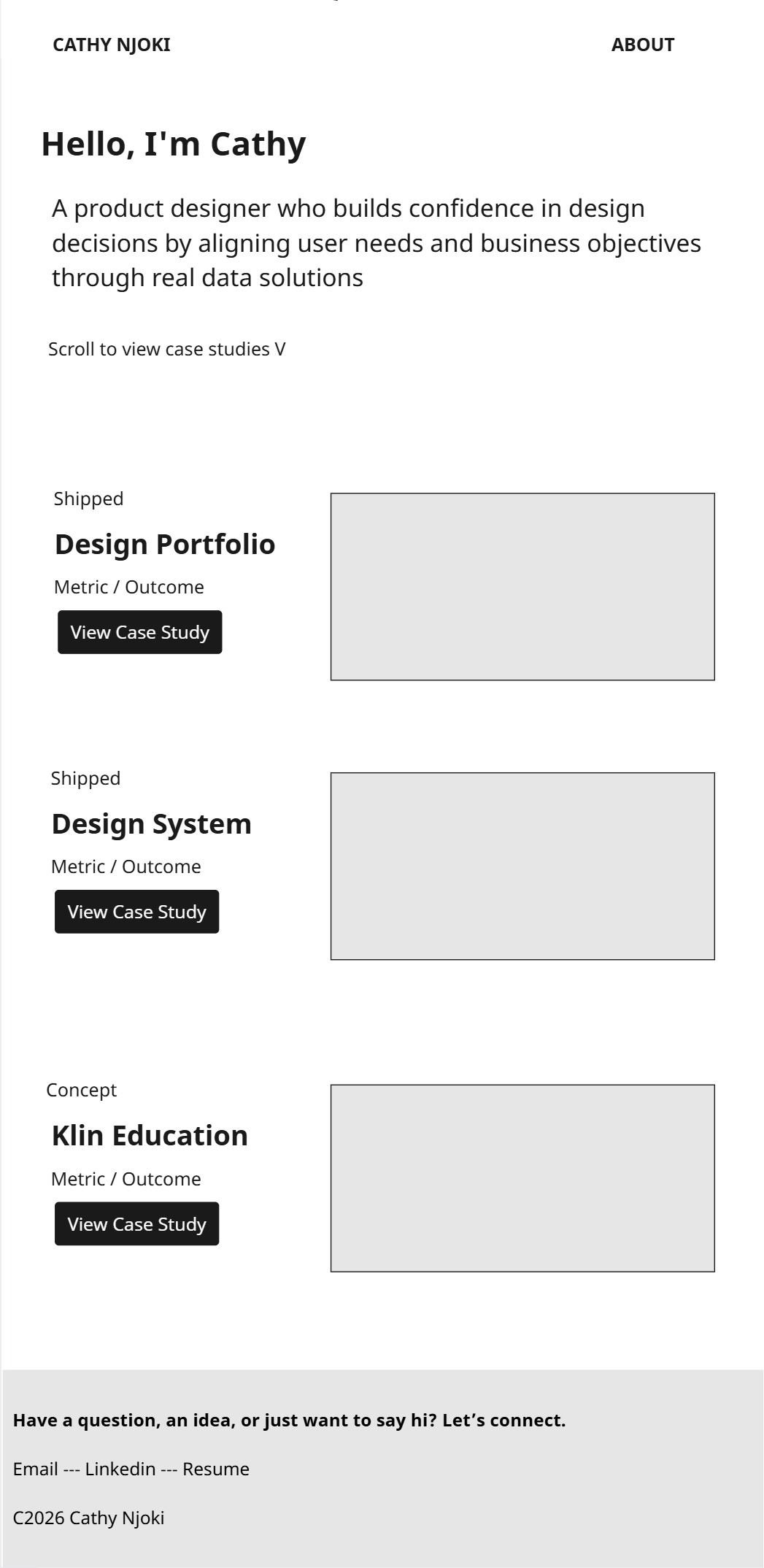
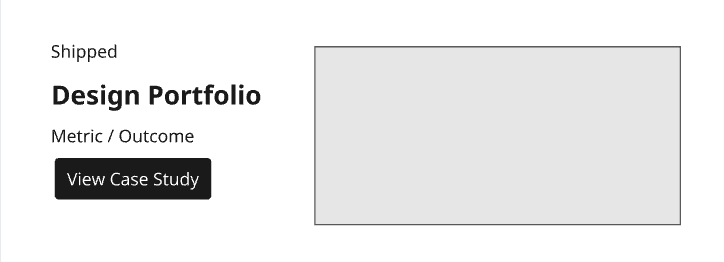
Quality case studies over a long list of content. Fewer choices make evaluation faster and impact easier to see.
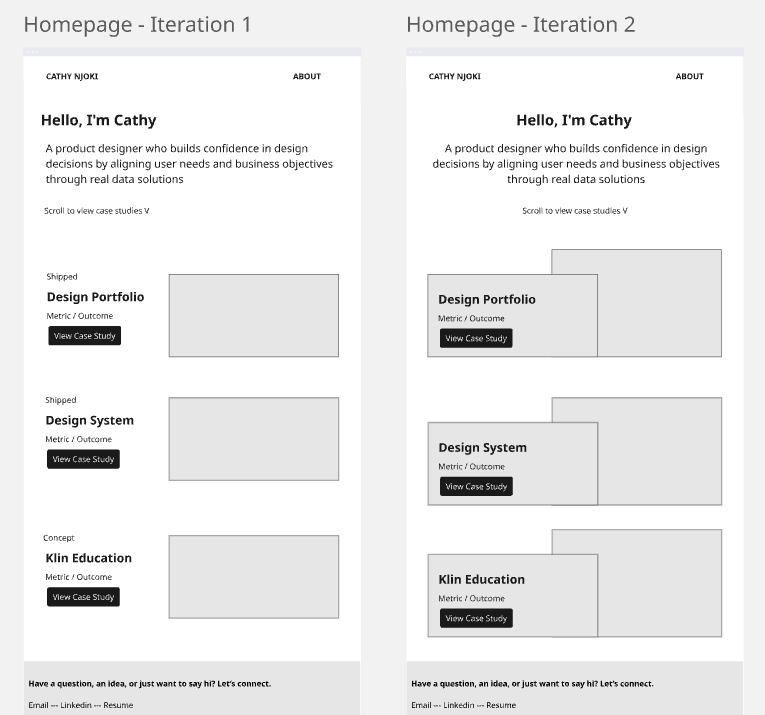
Key results, business objective, performance, and impact are visible before the hiring decision maker even clicks - and reinforced through an executive summary at the top of every case study.






Business name

CATHY NJOKI

ABOUT


Redesigning my portfolio to drive higher

conversions (+X%)


Background and business objective:

"Lorem ipsum dolor

sit amet, consectetur adipiscing elit, sed do eiusmod

tempor incididunt ut labore et dolore magna aliqua.


My Role vs others:


(Collab breakdown)


Duration

:

Lorem ipsum dolor


Result
:
Lorem ipsum dolor

image of redesigned product


Status:

Live

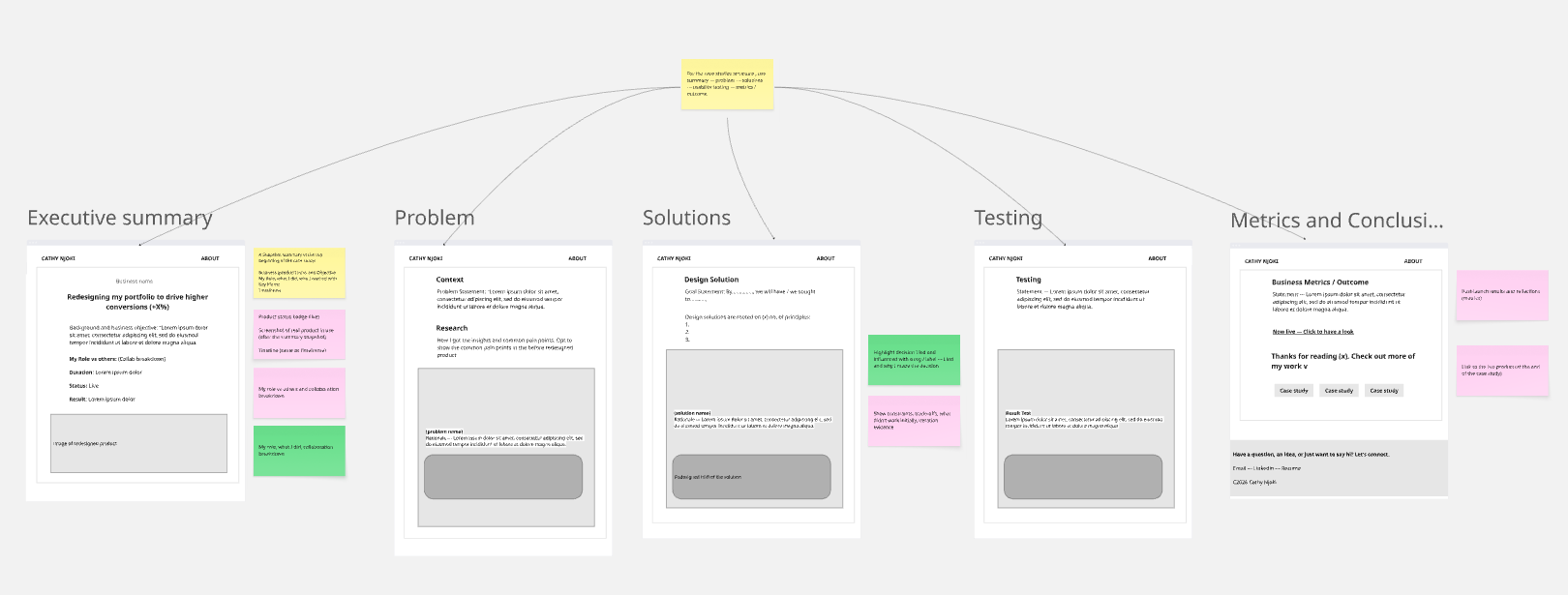
Every case study follows a defined structure - problem, research, decisions, testing, and results - so hiring decision makers can navigate predictably and assess real-world impact without getting lost.
To validate the design solutions before committing to a full build, I created an MVP site as a low-risk testing ground and made an unmoderated Maze test. However, two constraints got in the way;
I pivoted by building the site and reaching out directly to hiring decision makers and senior practitioners for feedback.
This kept iteration lean and fast and if gaps surfaced post-launch, they could be addressed with the site already live.
The redesigned portfolio is in its early stages of going live. Success will be tracked through two lenses;
This is it ! you're currently experiencing the redesign ;)
Design Portfolio
Design system
My previous portfolio was getting traffic but visitors were leaving without reaching out. That told me the work wasn't doing its job. I redesigned it with one clear goal: turn visitors into conversations.
Role: UX/UI Designer, CMS site build
Duration: 1 month
Status: Live
Results: In progress - (tracked via Google Analytics, with success measured by interview conversions and inquiries post-launch)
Between January and February 2026, the portfolio recorded 102 active users, 169 page views, and 423 events — but an average engagement time of 0s and a 55.6% bounce rate. Traffic existed. Engagement and action didn't.
The portfolio wasn't communicating what hiring decision makers needed to make a confident hiring decision.
I reviewed qualitative data from Reddit, X, and LinkedIn alongside industry articles and multimedia content. By synthesizing candid feedback from senior practitioners and hiring managers, I mapped the most common portfolio pain points shown below. (weighted by frequency across the sources - x% of insights)
Limited demonstration of business acumen (35%)
Insufficient evidence of real working behavior (29%)
Quality over quantity emphasis (18%)
Unclear individual contribution (18%)
Applying these insights to my previous portfolio revealed similar friction points.
The portfolio led with polished visuals and project quantity, but gave hiring decision makers little evidence of business thinking or measurable outcomes.
How Cathy worked, thought, and contributed was hidden behind expandable sections and thin project descriptions making it hard to assess fit quickly.
Press play to view the previous design↓
By making business acumen, individual impact, and real-world performance immediately visible, the goal was to give hiring decision-makers what they need to evaluate professional credibility fast.
The new portfolio design is grounded on these 3 principles;
Quality case studies over a long list of content. Fewer choices make evaluation faster and impact easier to see.
Key results, business objective, performance, and impact are visible before the hiring decision maker even clicks - and reinforced through an executive summary at the top of every case study.






Business name

CATHY NJOKI

ABOUT


Redesigning my portfolio to drive higher

conversions (+X%)


Background and business objective:

"Lorem ipsum dolor

sit amet, consectetur adipiscing elit, sed do eiusmod

tempor incididunt ut labore et dolore magna aliqua.


My Role vs others:


(Collab breakdown)


Duration

:

Lorem ipsum dolor


Result
:
Lorem ipsum dolor

image of redesigned product


Status:

Live

Every case study follows a defined structure - problem, research, decisions, testing, and results - so hiring decision makers can navigate predictably and assess real-world impact without getting lost.
To validate the design solutions before committing to a full build, I created an MVP site as a low-risk testing ground and made an unmoderated Maze test. However, two constraints got in the way;
I pivoted by building the site and reaching out directly to hiring decision makers and senior practitioners for feedback.
This kept iteration lean and fast and if gaps surfaced post-launch, they could be addressed with the site already live.
The redesigned portfolio is in its early stages of going live. Success will be tracked through two lenses;
This is it ! you're currently experiencing the redesign ;)
Design Portfolio
Design system
My previous portfolio was getting traffic but visitors were leaving without reaching out. That told me the design wasn't doing its job. I redesigned it with one clear goal: turn visitors into conversations.
Between January and February 2026, the portfolio recorded 102 active users, 169 page views, and 423 events — but an average engagement time of 0s and a 55.6% bounce rate. Traffic existed. Engagement and action didn't.
The portfolio wasn't communicating what hiring decision makers needed to make a confident hiring decision.
I reviewed qualitative data from Reddit, X, and LinkedIn alongside industry articles and multimedia content. By synthesizing candid feedback from senior practitioners and hiring managers, I mapped the most common portfolio pain points shown below. (weighted by frequency across the sources - x% of insights)
Limited demonstration of business acumen (35%)
Insufficient evidence of real working behavior (29%)
Quality over quantity emphasis (18%)
Unclear individual contribution (18%)
Applying these insights to my previous portfolio revealed similar friction points.
The portfolio led with polished visuals and project quantity, but gave hiring decision makers little evidence of business thinking or measurable outcomes.
How Cathy worked, thought, and contributed was hidden behind expandable sections and thin project descriptions making it hard to assess fit quickly.
Press play to view the previous design↓
By making business acumen, individual impact, and real-world performance immediately visible, the goal was to give hiring decision-makers what they need to evaluate professional credibility fast.
The new portfolio design is grounded on these 3 principles;
Quality case studies over a long list of content. Fewer choices make evaluation faster and impact easier to see.
Key results, business objective, performance, and impact are visible before the hiring decision maker even clicks - and reinforced through an executive summary at the top of every case study.






Business name

CATHY NJOKI

ABOUT


Redesigning my portfolio to drive higher

conversions (+X%)


Background and business objective:

"Lorem ipsum dolor

sit amet, consectetur adipiscing elit, sed do eiusmod

tempor incididunt ut labore et dolore magna aliqua.


My Role vs others:


(Collab breakdown)


Duration

:

Lorem ipsum dolor


Result
:
Lorem ipsum dolor

image of redesigned product


Status:

Live

Every case study follows a defined structure - problem, research, decisions, testing, and results - so hiring decision makers can navigate predictably and assess real-world impact without getting lost.
To validate the design solutions before committing to a full build, I created an MVP site as a low-risk testing ground and made an unmoderated Maze test. However, two constraints got in the way;
I pivoted by building the site and reaching out directly to hiring decision makers and senior practitioners for feedback. This kept iteration lean and fast and if gaps surfaced post-launch, they could be addressed with the site already live.
The redesigned portfolio is in its early stages of going live. Success will be tracked through two lenses;
This is it ! you're currently experiencing the redesign ;)
Design portfolio
Design system